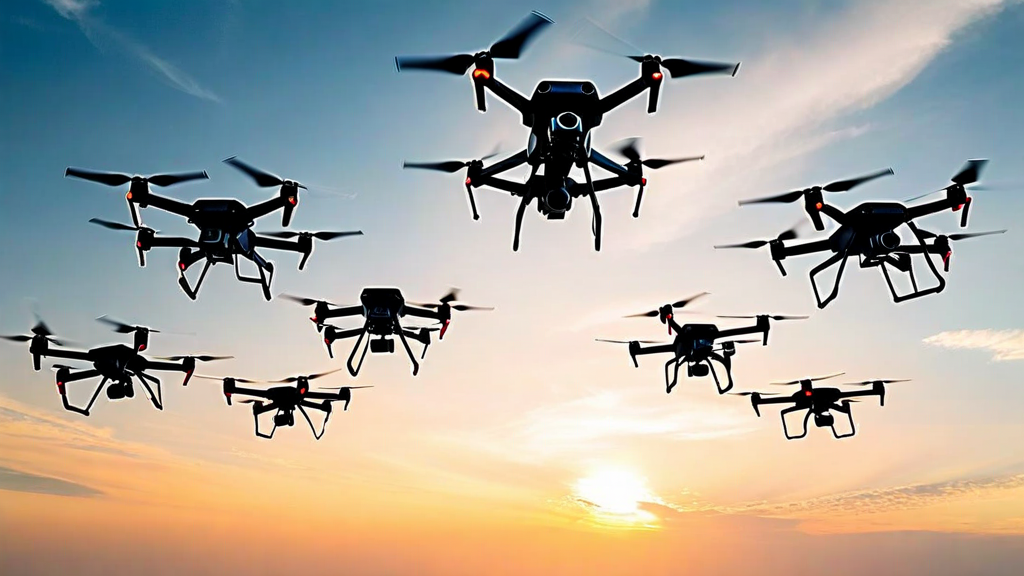
The ability to coordinate multiple unmanned aerial vehicles operating simultaneously as a unified system — what researchers and engineers call a drone swarm — represents one of the most technically challenging and potentially transformative frontiers in autonomous systems development. Where a single drone is constrained by its payload capacity, sensor coverage, and endurance, a swarm of coordinated drones can collectively accomplish tasks that would be impossible or prohibitively time-consuming for any individual aircraft.
Industrial applications of swarm technology are moving from research laboratories into commercial deployment, driven by use cases in large-area inspection, search and rescue, mapping of extensive terrain, and construction site monitoring that require coverage rates or redundancy levels that no single drone can provide. Understanding the architectural principles, coordination algorithms, and operational challenges of multi-drone systems is increasingly relevant for enterprise organizations evaluating how to evolve their aerial data operations beyond single-vehicle deployments.
Swarm Architecture: Centralized vs. Distributed Control
The fundamental architectural question in multi-drone system design is how control authority is distributed across the vehicles. In centralized architectures, a ground control station or a designated "leader" drone makes all coordination decisions and distributes commands to individual vehicles. In distributed architectures, each drone makes local decisions based on its own sensor data and communication with neighboring vehicles, with swarm-level behavior emerging from the collective application of individual behavioral rules.
Centralized architectures offer precise global optimization — a central planner with full knowledge of all vehicles' positions, capabilities, and the mission objective can compute optimal task allocation and flight paths for the entire swarm. The limitation is scalability and resilience: centralized systems require reliable communication between all nodes and the central controller, and are vulnerable to single points of failure. As swarm size grows, the communication bandwidth and computational load at the central controller grow accordingly, creating practical limits on scale.
Distributed architectures draw inspiration from biological swarms — the flocking behavior of birds, the collective navigation of ant colonies, the self-organization of schooling fish. Each individual agent follows simple rules based on local information: maintain separation from neighbors, align heading with neighbors, and cohere toward the center of the local group. The emergent behavior of many agents following these rules produces coherent collective motion without any central coordinator. Distributed drone swarms based on these principles are inherently resilient — the loss of individual vehicles does not disrupt swarm cohesion, and there is no single failure point that can collapse the entire system.
Practical commercial swarm systems typically employ hybrid approaches: a centralized mission planner assigns high-level objectives and initial task distributions, while distributed onboard algorithms handle real-time collision avoidance, formation maintenance, and dynamic re-tasking in response to local conditions. This architecture combines the global optimization capability of centralized planning with the real-time responsiveness and resilience of distributed execution.
Communication and Coordination Protocols
Reliable inter-drone communication is the foundation of swarm coordination. Drones must exchange position data, status information, sensor readings, and coordination commands with sufficient frequency and reliability to maintain cohesion and avoid collisions in three-dimensional space. The communication architecture must function even under RF interference, partial link degradation, and in environments where ground-station communication is intermittent or unavailable.
Mesh networking approaches, where each drone acts as a relay node passing information to and from other drones in the swarm, provide inherent resilience against individual link failures. Even if a drone loses direct communication with the ground station, it can relay communications through neighboring vehicles. Protocols like 802.11s (Wi-Fi mesh) and purpose-built UAV mesh networking stacks implement these capabilities with the low latency and high reliability required for real-time flight coordination.
Time synchronization across all vehicles is critical for coordinated behaviors that depend on actions occurring simultaneously — synchronized photographic capture for 3D reconstruction, coordinated formation changes, simultaneous multi-point inspections. GPS-disciplined clocks or precision time protocol (PTP) synchronization over the mesh network can achieve microsecond-level time synchronization across swarm members, enabling precise temporal coordination without a central timing signal.
Task Allocation and Mission Planning for Swarms
Assigning tasks to individual drones in a swarm to maximize mission efficiency is a combinatorial optimization problem that scales rapidly in complexity as swarm size increases. For a coverage mission — surveying a large area with a swarm of drones — the planner must partition the area into coverage sectors, assign sectors to individual drones, and generate flight paths for each vehicle that collectively cover the entire area with the required overlap and resolution, while respecting each vehicle's battery constraints and maintaining safe separations between all aircraft.
Market-based allocation algorithms, where drones "bid" for tasks based on their current position and resource state, provide a practical distributed approach to this problem. A drone near a task area will bid low (it can reach the task cheaply), while a distant or low-battery drone will bid high. The system allocates tasks to the lowest bidder, producing near-optimal allocations without requiring a central planner to maintain a global picture of the swarm state. These algorithms adapt naturally to dynamic task environments where new inspection targets emerge during a mission or drones fail and their incomplete tasks need to be redistributed.
For inspection applications where the coverage requirement is not a uniform area but a set of specific inspection points on a complex three-dimensional structure, swarm task allocation becomes a variant of the multi-agent vehicle routing problem. Optimal solutions are computationally intractable for large problem instances, but heuristic algorithms including genetic algorithms, simulated annealing, and particle swarm optimization produce near-optimal solutions within acceptable computation time for typical industrial inspection scenarios.
Collision Avoidance in Close-Proximity Swarms
Operating multiple drones in close proximity — the configuration required for efficient coverage of areas that individual drone range cannot cover in isolation, or for tasks requiring simultaneous multi-angle data capture — requires collision avoidance systems that operate at higher reliability and lower latency than those designed for single-drone operations in open airspace. A collision between two drones mid-mission could cause both to fall, potentially damaging equipment or injuring workers below.
Onboard collision avoidance in swarm configurations uses a combination of relative positioning derived from real-time kinematic (RTK) GPS or ultra-wideband (UWB) ranging, optical flow and stereo vision, and shared position data from the mesh communication network. The collision avoidance algorithm maintains minimum separation distances between all pairs of nearby aircraft by computing and applying avoidance maneuvers when projected trajectories would violate separation minima.
Velocity obstacle algorithms, reciprocal velocity obstacles (RVO), and ORCA (Optimal Reciprocal Collision Avoidance) represent a class of decentralized collision avoidance algorithms well-suited to drone swarms because they compute avoidance maneuvers that are mutually consistent — when two drones independently compute their respective avoidance maneuvers, the resulting maneuvers are guaranteed not to create a new collision threat, avoiding the oscillation and deadlock that simpler reactive avoidance approaches can produce.
Commercial Applications of Drone Swarms
Large-area infrastructure inspection is among the most commercially developed applications for drone swarms. Surveying a major solar farm, a wind energy installation, or an extensive pipeline corridor with a single drone operating sequential flight lines requires many hours; a swarm of coordinated drones can complete the same coverage in a fraction of the time by parallelizing the survey across multiple vehicles operating simultaneously. For time-critical inspection applications — post-storm damage assessment, pre-commissioning survey of new infrastructure installations — this speed advantage translates directly to operational value.
Search and rescue is an application domain where multi-drone coordination provides capabilities that are genuinely difficult to replicate with any alternative approach. A swarm of drones equipped with thermal cameras and coordinated by a search pattern allocation algorithm can systematically cover a large wilderness search area much faster than sequential single-drone operations, and the collective sensor data from multiple vehicles simultaneously scanning overlapping areas increases detection probability for subjects with low thermal contrast.
Precision agriculture deployment of swarm technology enables coordinated variable-rate spraying, seeding, and monitoring operations at rates that match the needs of large commercial farms. A coordinated swarm of agricultural drones can apply inputs at variable rates across a large field in a single operation, with each drone covering its assigned sector while maintaining safe separations from its neighbors and coordinating refill cycles to maintain continuous coverage.
Key Takeaways
- Drone swarms use centralized, distributed, or hybrid control architectures — each with distinct tradeoffs in optimization capability and resilience
- Mesh networking and time synchronization protocols are fundamental enablers of swarm coordination in GPS-challenged and communications-degraded environments
- Market-based task allocation algorithms provide practical distributed solutions for dynamic mission environments without requiring central planners
- Decentralized collision avoidance algorithms like ORCA provide provably safe multi-vehicle separation maintenance
- Large-area inspection, search and rescue, and precision agriculture are leading commercial applications for swarm deployment
- Hybrid architectures combining centralized mission planning with distributed real-time execution represent the most practical approach for enterprise applications
Conclusion
Autonomous drone swarm technology has advanced from theoretical research into practical commercial deployment across a growing range of applications. The core coordination algorithms, communication protocols, and collision avoidance systems needed to operate multi-drone systems reliably in real-world environments are now mature enough to support commercial operations with appropriate operational procedures and monitoring.
The organizations moving earliest into swarm deployment for industrial inspection and large-area survey applications are accumulating operational experience and mission data that will inform the next generation of system development. As individual drone platforms continue to improve and the cost of capable multi-drone deployments continues to decline, swarm-based approaches will become standard practice for inspection and survey programs where the speed and coverage advantages over single-vehicle operations justify the additional coordination complexity.